I’m Sam Dalrymple, a historian and author of Travels of Samwise and . Today we're diving into the discovery of Aristotle’s gymnasium. And we'll be back next week covering a controversial dinosaur fossil auction. Sign up here to make sure you don't miss it!
|
|
|
I set out to meet archaeologist Angeliki Kottaridi in mid-August, as the temperature of the Pierian range had begun to drop, and the first of the wild cyclamen was beginning to blossom across the Greek countryside.
Kottaridi is an energetic eccentric, who began her career studying witches in Greek myth and is now the proud owner of several dozen cats. A former assistant to archaeologist Manolis Andronikos, who found Philip of Macedon's tomb in 1977, Kottaridi later led the Greek excavation of Failaka, the most important Hellenistic site in Kuwait. She was awarded the Gold Cross of the Order of the Phoenix, and has probably done more than anyone else alive to bring back the world of ancient Macedonia. Her newest discovery, however, trumps all of her previous excavations.
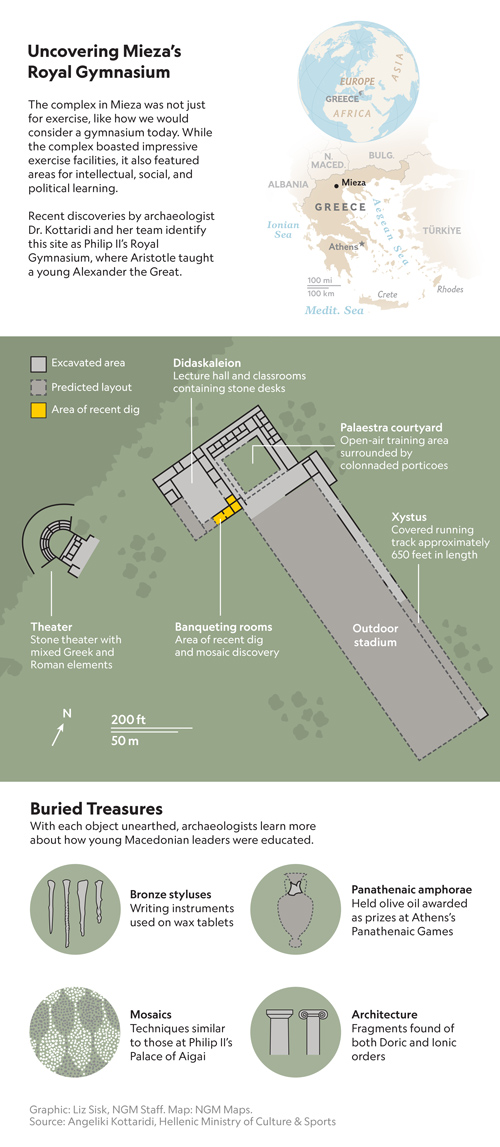
Two years ago, Kottaridi began challenging decades of archaeological orthodoxy, which tentatively identified a series of grottoes as part of the legendary Mieza Gymnasium, the school where the great philosopher Aristotle taught Alexander the Great. Kottaridi believed that the grottoes were but the tip of the iceberg. The gymnasium itself, she argued, lay underneath a series of olive groves two kilometers to the east. Her instinct proved correct, and Kottaridi and her team have now uncovered a mammoth structure containing the remains of—among other things—four bronze styluses, possibly the pens of Aristotle's pupils. They have found a 200-meter-long xystos, or covered running track, two stories high, and a lecture room where students may have studied. The complex, Kottaridi argues, was laid out to a single design and stood finished in 343 B.C.—exactly when Aristotle is said to have arrived.
|
|
|
If Kottaridi’s identification is right, Aristotle’s gymnasium was no rural arcadia but instead an enormous royal institution, and may have even served as inspiration for the Library of Alexandria. “It is truly an amazing find,” Alexander’s biographer Robin Lane Fox told me later. “We can walk where they walked and stand where Aristotle took Alexander through the text of the Iliad, his lifelong inspiration.”
|
|
|
My drive from Thessaloniki was unassuming and industrial, but as the road climbed the foothills towards Aigai, the ancient capital of Macedon, the otherwise bleak landscape gave way to forested hillsides of oak and chestnut.
It was from Aigai that Alexander set off to fight the Persians, and within a few years, by the age of 30, Alexander would be ruler of the known world, an empire reaching south to modern Egypt, north to modern Tajikistan, and east to the Beas River in what is now India.
The tombs at Aigai, still mostly unexcavated, have thrown up some of the most extraordinary discoveries in classical Greece. Excavation on Aigai’s Palace, built by Philip of Macedon, was only completed and opened to the public in 2024, yet it is now reckoned to be the largest palace anywhere in classical Greece, three times the size of the Parthenon.
|
|
|
Archaeologists in northern Greece have uncovered classrooms they believe to be part of the school complex where Aristotle taught the young Alexander the Great. The discoveries have been made at the Royal Gymnasium of Mieza, near the modern city of Naoussa.
|
|
|
Mieza lies a short drive to the north, among the orchards that dot the foot of Mount Vermio, and it was here as the archaeologists were packing up to avoid the midday sun that I met Kottaridi for the first time.
She came out to meet me almost at a run dressed in a white linen shirt and shorts, with bright red glasses, and her mop of brown hair tied back into a ponytail. After a quick hello, she began excitedly showing me around, a sheaf of maps in plastic sleeves tucked under one arm.
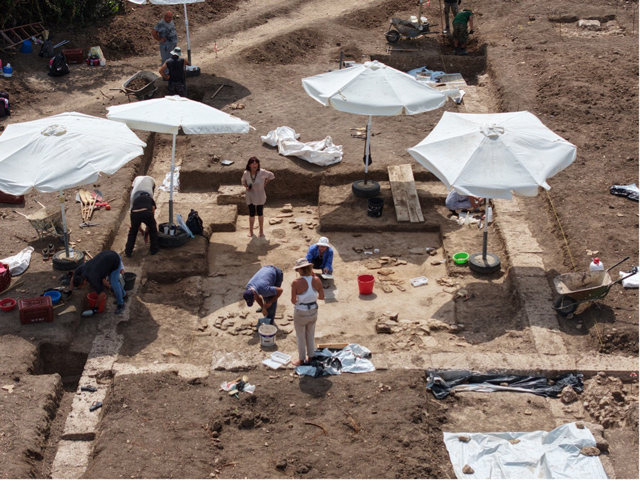
The dig had the look of a film set, which felt about right for a discovery on this scale. Drones buzzed overhead to photograph the site, plastic sheeting was pegged down over newly exposed walls, and white parasols erected all over the place shaded archaeologists from the sun. The site, Kottaridi kept exclaiming, was far larger than she had ever imagined.
|
|
|
Alexander’s studies here in Mieza began in the year 343 B.C., when Philip of Macedon invited the greatest philosopher of the age to sail north and join his court as tutor to his son. Aristotle had spent 20 years at Plato’s Academy in Athens, but after being passed over as head of the school, he had begun spending his time dissecting sea creatures on the shores of Lesbos instead. His new role as head of the Mieza Gymnasium would cement his fame forever.
Aristotle would not have known it then, but his pupils would go on to remake the world. Cassander would become the king of Macedon and overlord of Greece, while Ptolemy would rule Egypt as pharaoh and found the Library of Alexandria. Of course, most extraordinary of all was Alexander himself, and in the words of Lane Fox, “the contact between Greece’s greatest mind and her greatest conqueror … has occupied the imagination ever since.”
|
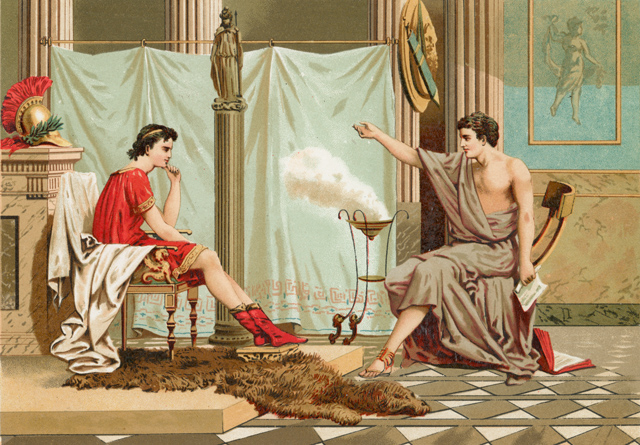
In 343 B.C., Philip of Macedon invited Aristotle, the greatest philosopher of his age, to join his court as tutor to his son as head of the Mieza Gymnasium. Aristotle would not have known it then, but his pupil Alexander the Great would go on to remake the world.
|
ARTWORK BY ARMET PORTANELL, LOOK AND LEARN/BRIDGEMAN IMAGES
|
A medieval French poet describes how Aristotle taught the young Alexander “the nature of the sea and the winds; he explained the course of the stars, the revolutions of the firmament and the lifespan of the world.” The philosopher Bertrand Russell imagined that Alexander “would have been bored by the prosy old pedant,” while Lane Fox argued that to a 14-year-old, Aristotle “would seem less the abstract philosopher than the man who knew the ways of the cuttlefish, who knew why wrynecks had a tongue or how hedgehogs would mate standing up.”
Aristotle himself, however, never wrote about his time at the Macedonian court—or at least no writings of his about the subject survive. Aristotle’s gymnasium, likewise, was lost for millennia. The last known author to describe the site was Plutarch writing in the first century A.D. of a “precinct of the nymphs near Mieza, where to this day the visitor is shown the stone seats and shady walks of Aristotle.”
Kottaridi’s excavations remain in an early phase, and the complex is clearly much larger than what has been excavated so far, which amounts essentially to a floor plan rather than a fully intact building. A series of nearby Macedonian tombs, however, hint at the colorful painted exteriors that might have once characterized Aristotle’s gymnasium. These tombs are today completely devoid of tourists yet contain some of the best-preserved painting to survive from the ancient world.
|
TUUL AND BRUNO MORANDI, ALAMY
|
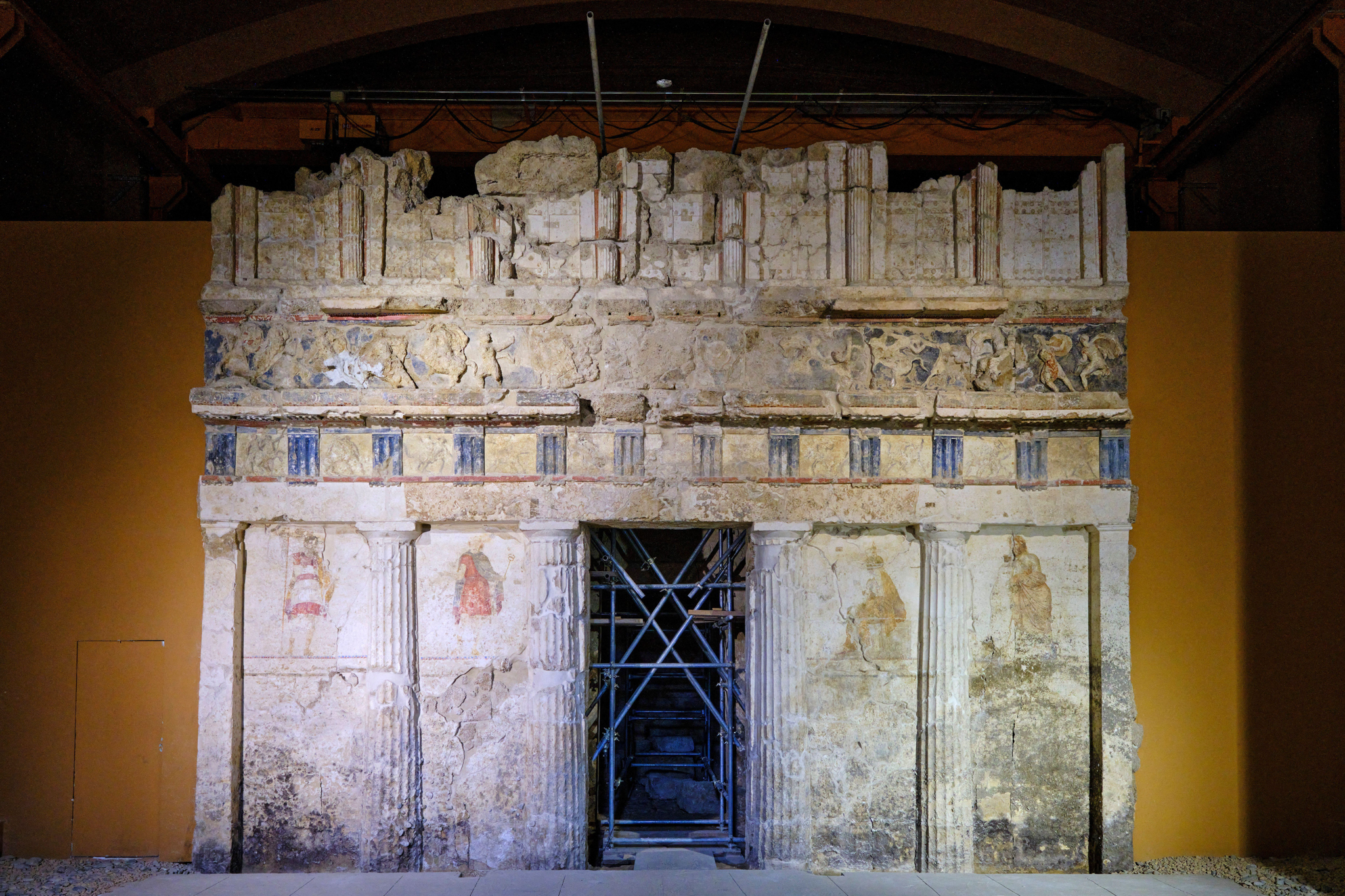
The colorful paintings on the exterior of the Tomb of the Palmettes and other nearby Macedonian tombs may offer clues to how Aristotle’s gymnasium looked.
|
The Tomb of Lyson and Kallikles, for example, holds one of the earliest surviving examples of perspective in Greek art, showing in vivid color the military paraphernalia of a Macedonian aristocratic family. The nearby Tomb of the Palmettes, meanwhile, has a painted facade of an ancient Greek temple, with four Ionic columns supporting a painted pediment, an example of how the Parthenon and its contemporary monuments would have looked before their painted exteriors began to fade.
The most remarkable tomb of all is the Tomb of Judgment. The largest Macedonian tomb ever discovered, it surpasses even the famed royal tomb of Philip II at Vergina. Along its painted relief frieze, Macedonian and Persian horsemen clash in swirling cloaks and lunging spears. Below, the god Hermes stands beside the judges of the underworld in an astonishing series of life-size frescoes. Scholars have long debated the identity of the person buried here, but the most tantalizing candidate is Peucestas of Mieza, one of Alexander’s celebrated bodyguards who defended the ruler after his lung was pierced by an arrow during a campaign on the Mallian citadel—probably the modern Pakistani city of Multan. Alexander appointed Peucestas governor of Persis, the Persian homeland of southern Iran, as a reward.
Erected just a generation after Aristotle taught Alexander’s companions at the gymnasium, the Tomb of Judgement is today our best indication of the way the gymnasium might have looked: not the bleached stone we see today, but plastered walls painted with delicate murals.
|
After touring the tombs, I drove to the nearby city of Veria where Kottaridi was waiting for me at a local fish restaurant. Over fresh seafood and fried cheese, she revealed more about her theories.
Almost none of Macedon’s buildings survive, she tells me, because the Macedonians were serious rivals to Rome. The Romans defeated the last Macedonian king in 168 B.C., and after a failed revolt 20 years later, Aigai and Pella were burned to the ground. Kottaridi’s excavations have found ash all over the site, suggesting that the royal gymnasium was “systematically destroyed” alongside the erstwhile capital as a symbol of the old pre-Roman regime.
|
|
|
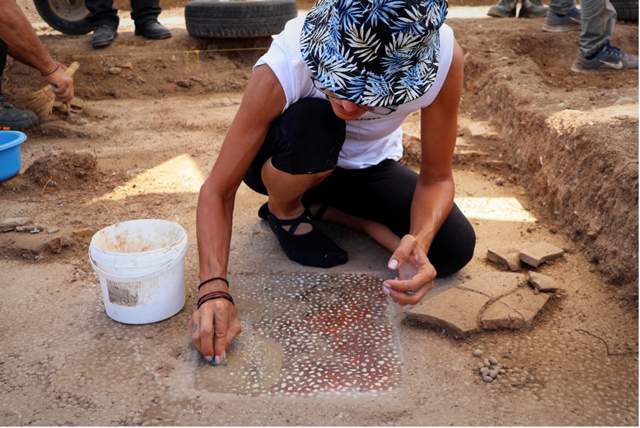
Excavations at Mieza began in 2024 under archaeologist Angeliki Kottaridi, honorary curator of antiquities, as part of an agreement between Greece's Ministry of Culture and the Municipality of Naoussa. Archaeologists have uncovered parts of a palaestra, or wrestling area, a stadium, covered walkways, classrooms, and even a roofed running track, or xystos measuring about 200 meters in length.
|
|
|
Yet what is becoming increasingly clear is that by the time of Alexander, Macedon was more important than Athens. Its influence is everywhere in the Hellenistic world, the Greek-speaking civilization that Alexander’s conquests spread from Egypt to India. Wherever Alexander’s successors established cities, they built gymnasia like the one at Mieza: at Ai Khanoum in Afghanistan, in Babylon, in Jerusalem. Kottaridi believes even the Library of Alexandria, founded by former Mieza student Ptolemy, was modeled on it.
Some of the columns at the xystos in Mieza can be raised upright again, Kottaridi told me, which would give future visitors a sense of the site’s scale. And in nearby Aigai, she added, there are over 500 unexcavated Macedonian burial mounds. Only a fraction of Mieza has so far been excavated. She smiled. "This is just the beginning of what we will find."
|
|
|
DESTINATION8INFINITY / WIKIMEDIA COMMONS, CC BY-SA 4.0
|
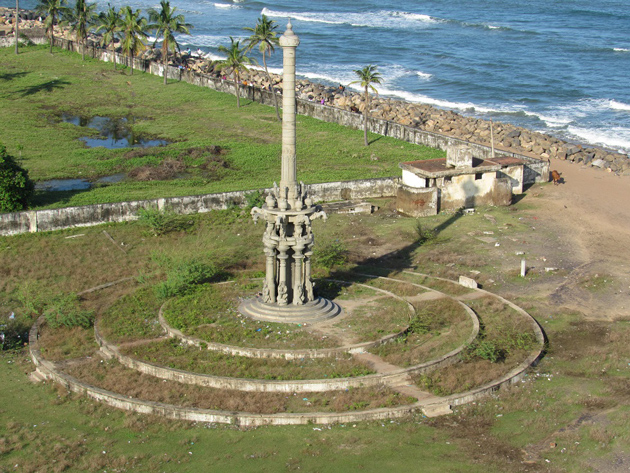
Archaeologists exploring off the coast of Poompuhar in Tamil Nadu, India, have discovered new evidence highlighting the importance of the ancient port city—and perhaps pushing the timeline of its trade with the Middle East much later than historians have assumed.
|
|
|
A Persian Gulf Jar on the Tamil Coast |
Off Poompuhar-Kaveripattinam on the south Indian coastline, an 18-day underwater survey by the Tamil Nadu State Department of Archaeology and the Indian Maritime University has recovered a fragment of a West Asian torpedo jar, a ceramic vessel used to transport liquids, along with four terra-cotta ring wells, often used as drainage pipes in the ancient world, and more than 250 ceramic sherds. These jars are a Parthian-to-early-Islamic type, seemingly much later than the Roman-era trade that has usually been found in this region. If the bitumen lining found inside can be sourced and dated, it may push the story of the Middle East’s trade with these ports much later than is typically assumed.
|
|
|
PHOTOGRAPH BY BILL HATCHER, NATIONAL GEOGRAPHIC IMAGE COLLECTION
|
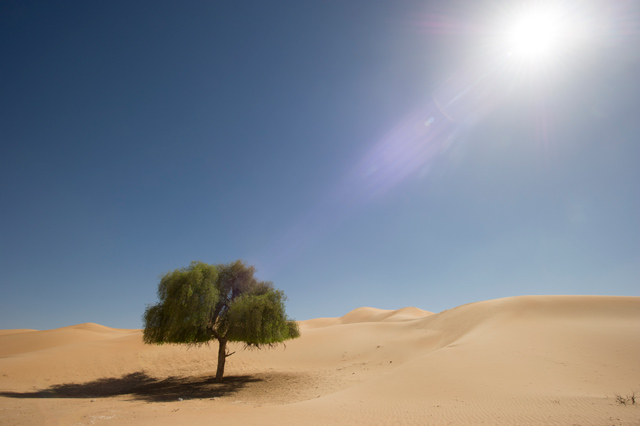
A tree grows in an area where the water table is just below the sands in the Rub al Khali desert in Oman. Scientists have found evidence that this land was once lush with freshwater lakes—although a new study suggests that water alone wasn’t the draw for ancient settlements.
|
How Early Humans Decided Where to Live in ‘Green Arabia’ |
It wasn’t just the water that drew early humans to settle in “Green Arabia”—the lush landscape of freshwater lakes and savanna-like grasslands that once dotted the present-day deserts of the Arabian Peninsula. A study published in Nature this week suggests that humans relied upon workable stone—which they could use for their tools—as much as they did fresh water.
|
|
|
ERIC LAFFORGUE, HANS LUCAS/REDUX
|
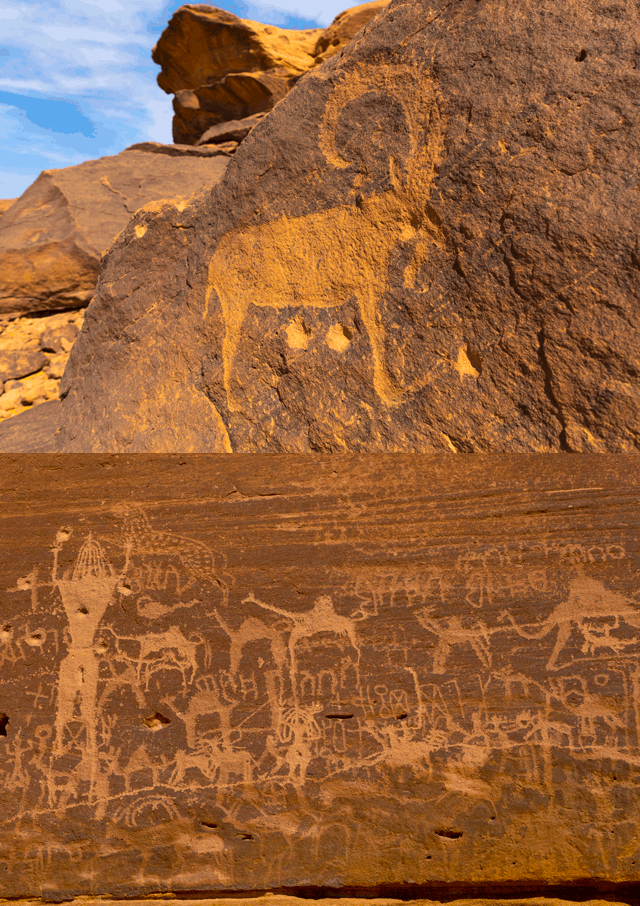
The discovery of these rock carvings in Najran Province, Saudi Arabia, suggests there were once human settlements here—lending evidence to the theory of a “Green Arabia.”
|
|
|
“Everyone working on early human dispersals in Arabia, me included, has assumed that if you could find the water you would find the people,” said National Geographic Explorer Jeffrey Rose—of the Interdisciplinary Centre for Archaeology and the Evolution of Human Behaviour at the University of Algarve in Portugal—in a press release. Rose and his co-authors combined field surveys with spatial modeling and found that archaeological evidence of human settlements clustered in places where both workable stone and water were found. As Rose noted, “Once you put stone on the map alongside water, Green Arabia shrinks by more than half, and what is left looks less like a corridor than a chain of islands.”
|
|
|
ARCHAEOLOGY & PALEONTOLOGY STORIES FROM AROUND THE WORLD |
|
|
DR. CLAUDIA SACHSSE, DEUTSCHES APOTHEKEN-MUSEUM (GERMAN PHARMACY MUSEUM), HEIDELBERG, GERMANY
|
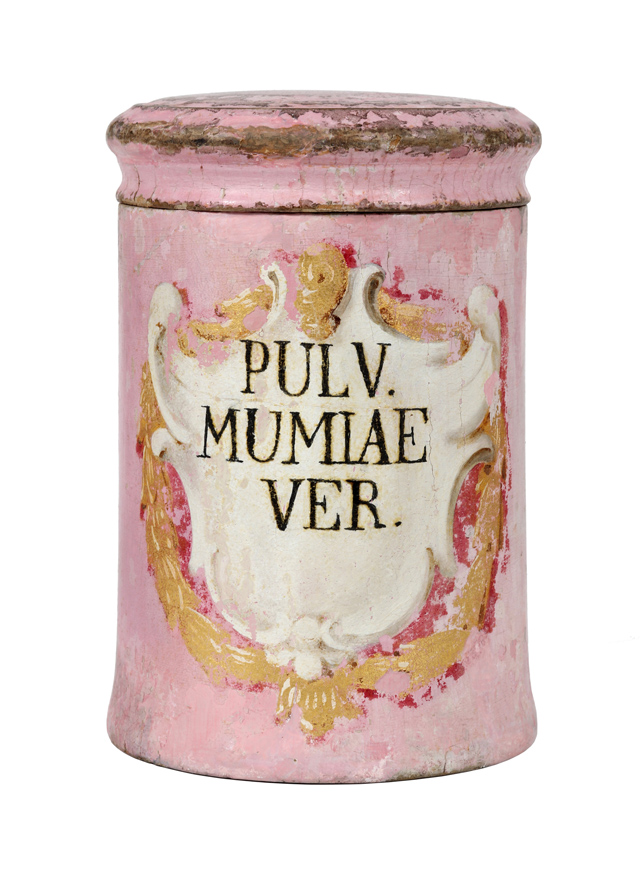
An apothecary in medieval Europe may have had jars like this one containing the substance Mumia vera aegyptiaca. Mumia vera was historically derived from Egyptian mummy materials and traded as a medicinal substance in European pharmacies for centuries.
|
What Exactly Did People Eat Back When People Ate Mummies? |
If you had a headache in medieval Europe, you may have been prescribed a strange remedy: Mumia vera aegyptiaca, a substance derived from ancient Egyptian mummies and their embalming materials. Inspired by the belief that a healthy human body held the power to heal other humans of their ailments, this form of so-called medical cannibalism was popular at the time.
But what exactly was in the Mumia vera powders peddled by medieval apothecaries? Scientists studied 24 samples held in museum and university collections and found several of them contained conifer resins as well as residues derived from aloe—which is the first evidence that the ingredient was used in Egyptian embalming. Intriguingly, the scientists also investigated whether the substances had bioactive properties that might support their medicinal use—and found that an extract of Mumia vera provided modest protection against the effects of influenza virus in infected cells.
|
|
|
Clicking on the Facebook, Instagram, and National Geographic Channel links will take you away from our National Geographic Partners site where different terms of use and privacy policy apply.
|
This email was sent to OKSOL@YAHOO.COM: Please do not reply to this email as this address is not monitored.
This email contains an advertisement from:
National Geographic | 1145 17th Street, N.W. | Washington, D.C. 20036
Stop all types of future commercial email from National Geographic regarding its products, services, or experiences.
Manage all email preferences with the Walt Disney Family of Companies.
© 2026 National Geographic Partners, LLC, All rights reserved.
|
|
|
|