Stones & Bones is back! I’m Nicholas St. Fleur, a science editor at National Geographic, and today we discover a new raptor in the mountains of Argentina.
Many of you work in the world of Stones & Bones. If you know of research that should be on our radar or interesting folks we should talk to, please contact me at Nicholas.St.Fleur@natgeo.com.
|
Some 70 million years ago, a slender, feathered raptor waded into a prehistoric river in southern Patagonia searching for prey.
|
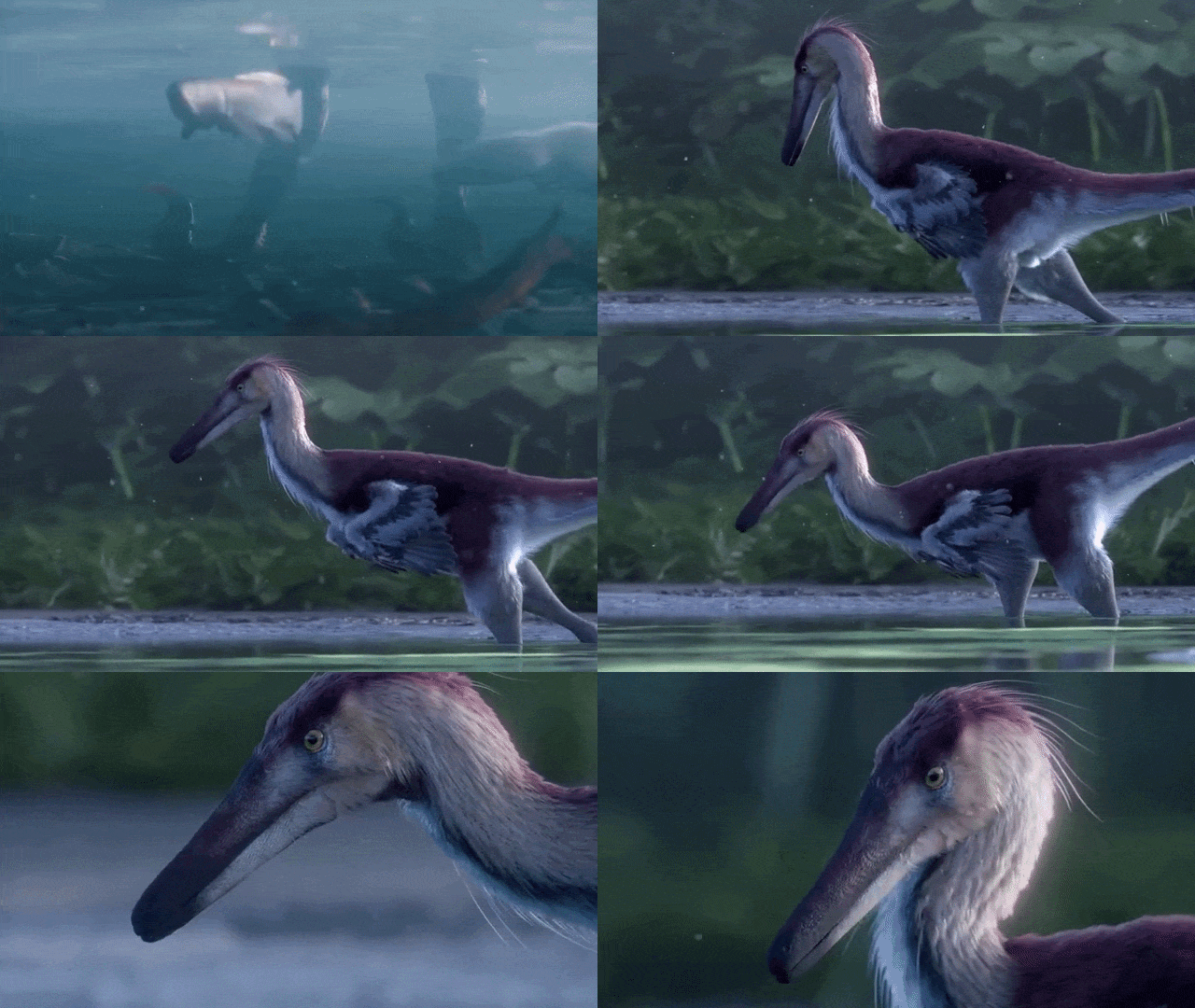
It crept forward on two legs, with its sickle-shaped toe claws submerged in the murky water. Eyes locked on something beneath the surface, it recoiled its serpentine neck like a loaded spring, then struck—snatching a fish between its teeth.
Meet Kank australis, a newly discovered raptor species that was announced in late spring in the Journal of Vertebrate Paleontology.
|
|
|
A paleoartist’s rendering of the newly discovered species
|
If Spinosaurus was a “hell heron” stalking shallow shores, then you can think of this 50-pound predator as an “evil egret” or a “dinosaur stork.” And paleontologists say it reveals a new glimpse into life before the asteroid impact that obliterated the non-avian dinosaurs.
“One of the clear patterns we’re seeing in southern South America is that dinosaur diversity was much higher than we thought,” says Diego Pol, a National Geographic Explorer and paleontologist at the Argentine Museum of Natural Sciences, who discovered the new species with his team. Pol, as Stones & Bones readers might remember, also recently found a new long-necked dinosaur, Bicharracosaurus dionidei, in Patagonia with the help of a reclusive shepherd. Pol is best known in paleontology circles for his discovery of the Patagotitan, perhaps the largest dinosaur ever found.
Historically, most of paleontology has focused on the Northern Hemisphere, especially in the United States. Kank, Pol says, is another example of the untold number of new species that could come from the southern region. These finds suggest dinosaurs there were thriving before the Cretaceous mass extinction event.
The story behind the discovery is just as thrilling as the find itself.
|
|
|
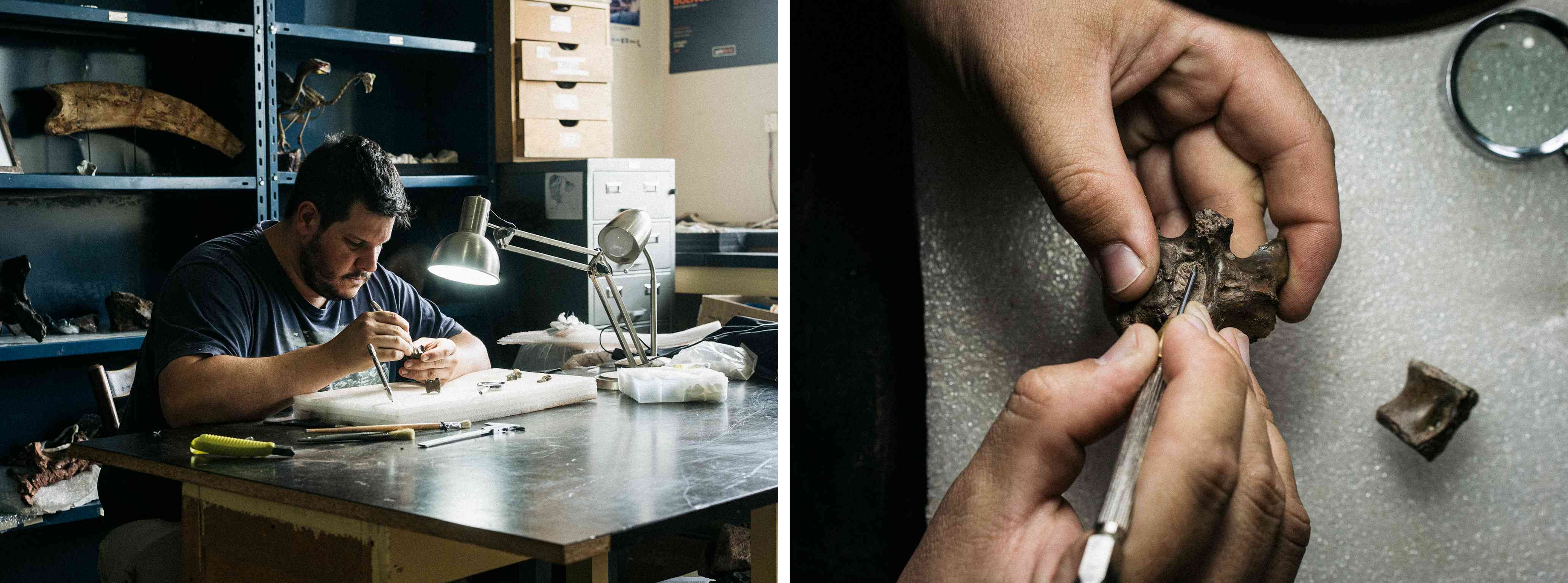
Gonzalo Muñoz, a technician at the Argentine Museum of Natural Sciences, has years of experience preparing fossils and discovered Kank’s neck vertebra in the field. He was also in charge of preparing the Kank materials in the laboratory.
|
During a recent visit to National Geographic headquarters, Pol told me that back in 2019, his team had found a fossil that screamed raptor because it was a fragment of the iconic kill claw on the second toe. They spent years searching for more specimens, ultimately turning up additional foot bones, a vertebra, and several curved teeth.
But the crucial fossil find came in 2024. As Pol’s colleagues crawled on their stomachs across the freezing Patagonian mountain tops, sifting through rocks and dirt by hand, a technician named Gonzalo Muñoz came across what appeared to be a minuscule neck bone. He showed it to National Geographic Explorer Matías Motta, then a newly minted Ph.D. who did his doctoral work on southern raptors.
“When I saw the vertebra, I recognized immediately that it was a raptor,” Motta says. “I said, That is a raptor vertebra! We found the fossil that we need to name this animal!”
Motta and the team celebrated back at the tents with wine and a big meal, eager to find more the next day. But the jubilation was short-lived: When they awoke the next morning, the entire mountain was blanketed in several feet of snow.
“It’s the worst situation because the snow covered the floor and we couldn’t see the fossils,” Motta says. Even worse, the snow made it treacherous for their trucks to descend the mountain.
Luckily, the team had already called in backup: the Argentine Army.
|
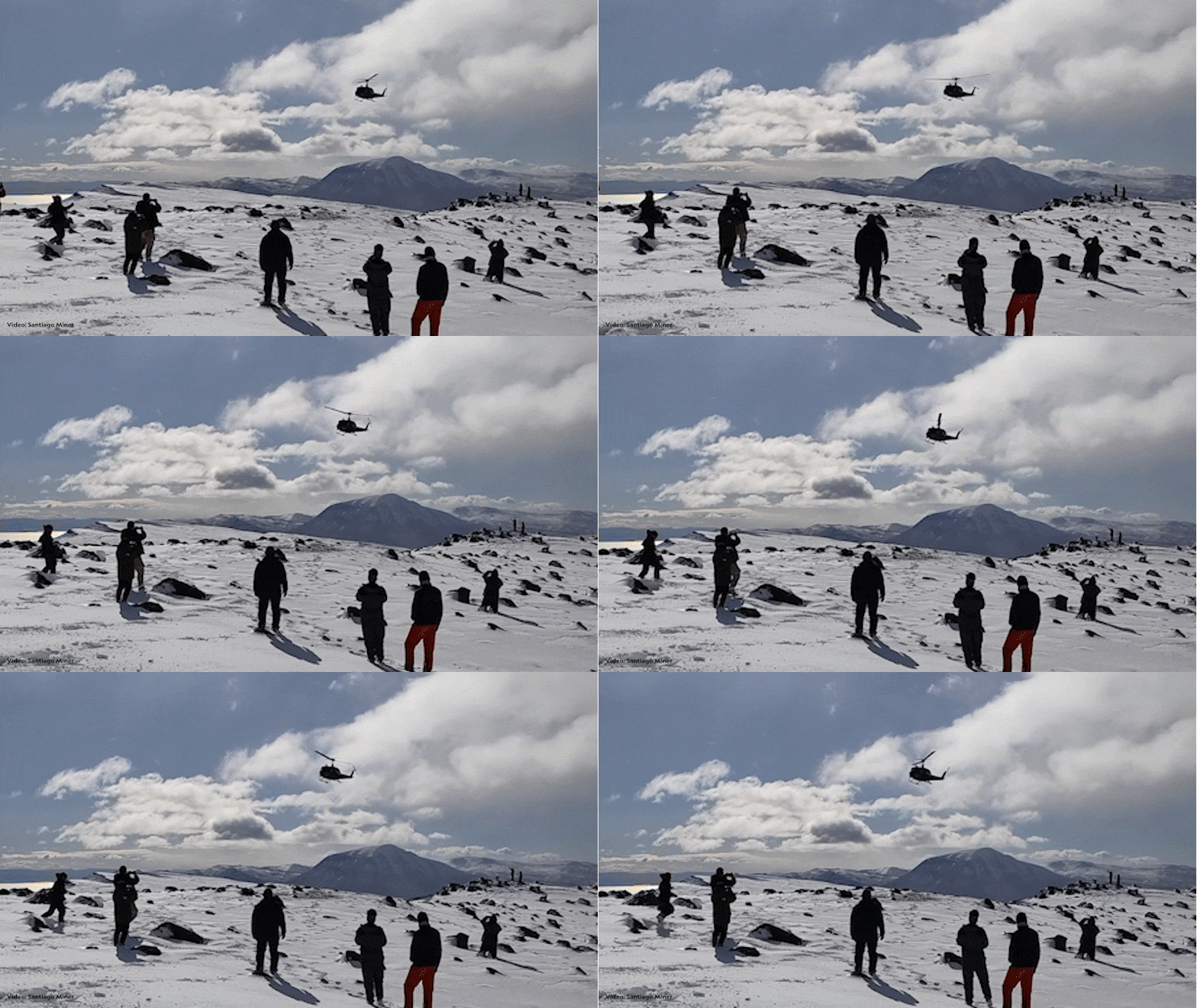
In 2024, while the team was working in the remote mountain region of Patagonia in Southern Argentina, a storm blanketed the area in snow. The terrain became too dangerous to pass by vehicle, forcing some of the scientists to evacuate by helicopter.
|
|
|
A massive titanosaur fossil they’d excavated and preserved in plaster the year before was due to be airlifted out by the Argentine Army. When the helicopter arrived, instead of giant titanosaur bones as passengers, some of the researchers hopped in the cabin—bringing with them the raptor’s neck bone. Left behind and still waiting in the mountains today were the titanosaur remains and, perhaps, the rest of the raptor.
“It’'s painful to leave a fossil in the field,” Pol says. But with the tiny neck bone, his team had what they needed to uncover the raptor’s identity.
Back at National Geographic HQ, Pol walked me through how each fossil helped solve the case. The toe bone told him it was a raptor. The teeth said it was a southern raptor. And the neck bone—filed with air cavities similar to the hollow bones seen in birds today—revealed it was a brand-new species. Kank belonged to a group of southern raptors known as the unenlagiids. Unlike the raptors you’re familiar with from Jurassic Park, unenlagiids had long, thin snouts filled with tiny, needlelike teeth ideal for catching fast, slippery fish.
“I think they’re supercool because they occupy a niche that no other dinosaur probably occupied that we know,” Pol says. “We believe it wandered close to the water, probably eating small prey that may have included small mammals, frogs, or fish.”
|
|
|
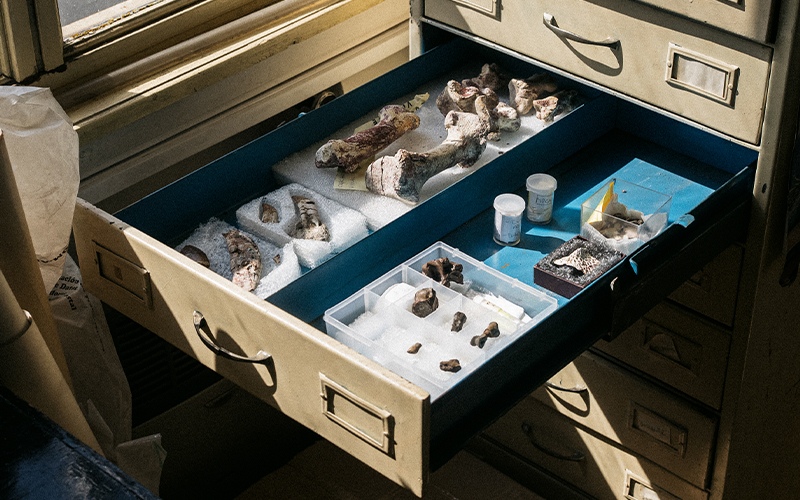
The materials are housed temporarily at the museum’s laboratory during their study. All fossils will be subsequently sent back to Patagonia to be permanently deposited at the Museo Padre Molina.
|
National Geographic Explorer Steve Brusatte, a paleontologist at the University of Edinburgh who has also studied southern raptors, was amazed when we met recently for lunch and I showed him Pol’s paper.
“That’s cool! Wow!” he said as he peered at my laptop to see the animated reconstruction Pol’s team made of Kank hunting fish. “They have these long snouts, which is a strange thing for a raptor. It makes total sense that they’re eating fish. The teeth seem to fit that as well.”
Afterward I sent him a copy of the paper to take a closer look. He emailed me back with more thoughts: “A discovery like this is both tantalizing and frustrating.”
Frustrating, he told me, because what they have is nowhere near a complete skeleton. But tantalizing because those few fragments are still enough to cement it as a new species. Even more enthralling, he added, was the dating, which places Kank at the dinosaurs’ last gasp. “It is yet more evidence that there were many birdlike dinosaurs thriving in those days before the asteroid hit.”
So why does any of this matter to you, me, or anyone living today?
The way Pol sees it, this period is the “Rosetta stone of extinction science.” The revelation that prehistoric environments like the river shores Kank once waded in were lush and diverse might help us better understand—and recognize—how a healthy ecosystem collapses on a global scale.
“We are facing a biodiversity crisis today. Some people are wondering if we are approaching a sixth mass extinction event,” Pol says, turning serious. “It’s very, very important to understand right now what was happening on our planet 66 million years ago.”
|
|
|
During my lunch visit with National Geographic Explorer Steve Brusatte earlier this summer, we chatted about more than just the new cool raptor Kank australis. We also talked about its closest living relative: birds.
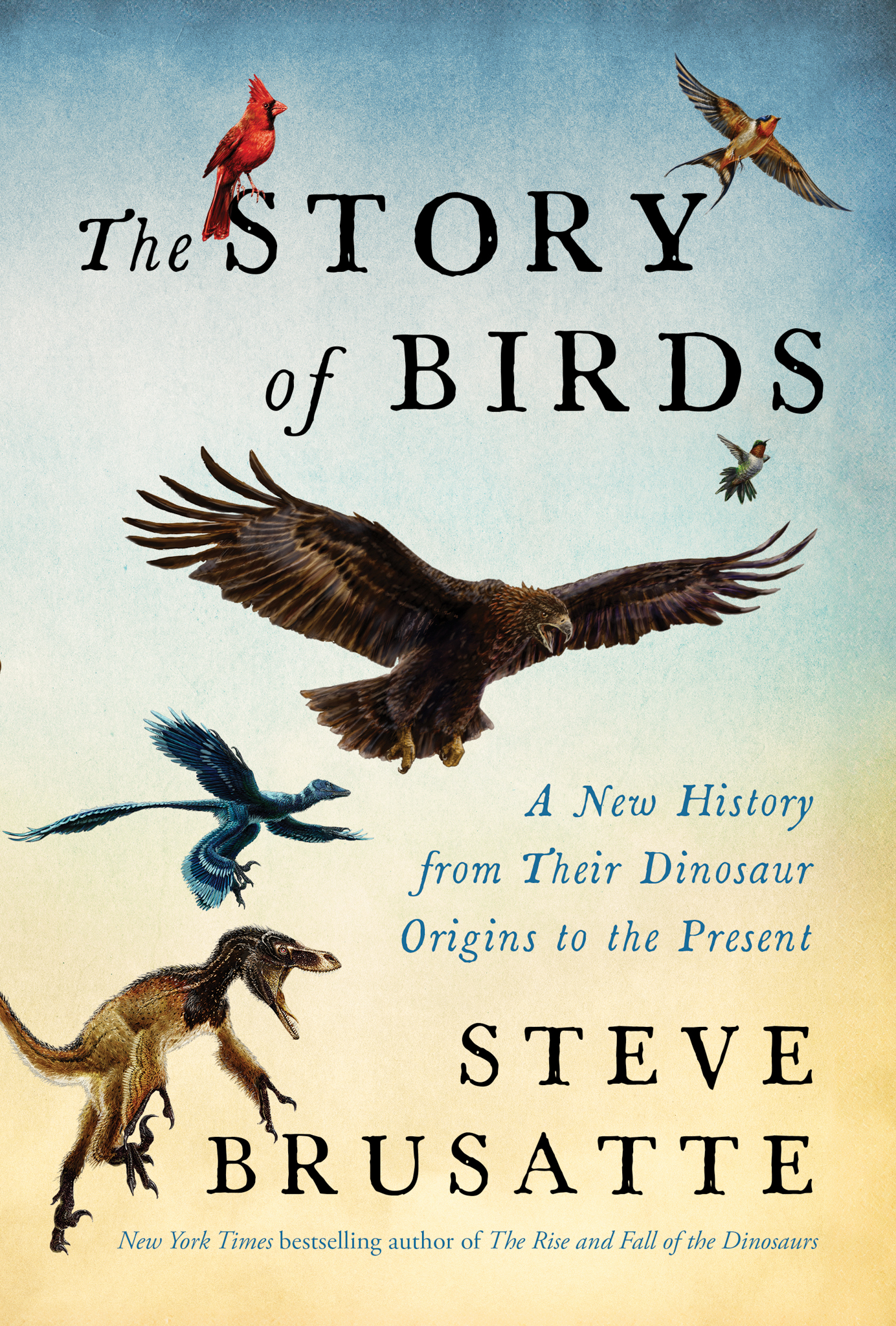
I had caught him ahead of his American book tour for his latest New York Times best seller, The Story of Birds: A New History From Their Dinosaur Origins to the Present.
“The first half of the book is pretty much how birds evolved from dinosaurs and how feathers and wings and flight evolved,” Brusatte told me. The second half documents what birds have done since making the evolutionary leap from dinosaurs. “They’ve done a lot!” he exclaimed. “That includes so many of these amazing extinct species: terror birds, elephant birds, and demon ducks!”
|
|
|
THIS WEEK’S MUST-READS FROM AROUND THE WEB |
|
|
TYRONE TURNER, NATIONAL GEOGRAPHIC IMAGE COLLECTION
|
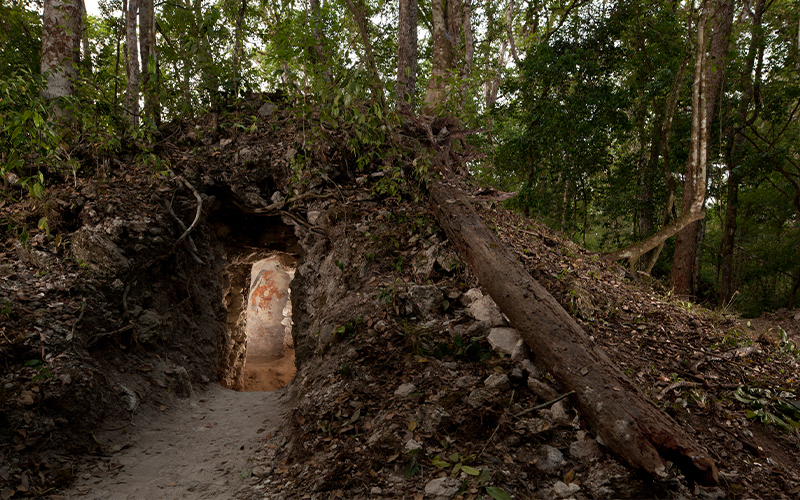
A Maya mural appears in a doorway hacked out by looters at the Xultún Maya archaeological site in Guatemala, 2011.
|
|
|
WE NOW KNOW THE NAME OF AN ANCIENT MAYA MATHEMATICIAN WHO DECODED THE STARS |
|
|
Ancient Greece had Pythagoras. Classical India had Aryabhata. Imperial China had Zhang Heng. Renaissance Europe had Kepler, Copernicus, and Galileo.
Now, for the first time, we know the name of an astronomer-mathematician from the ancient Maya.
National Geographic Explorer David Stuart (who took part in our Ask an Expert Anything series) and a team of archaeologists recently deciphered the scholar’s name along with his celestial calculations after analyzing hieroglyphics at the Maya ruins of Xultún in Guatemala. It is also the first time that scientists have been able to attribute an ancient Maya equation to a specific individual.
Maya astronomer-mathematicians have long lived in obscurity, uncredited for their science, Stuart tells National Geographic’s Taylor Mitchell Brown.
“Now,” Stuart says, “we have a name!”
|
|
|
Eager to learn more about this ‘evil egret’? Check out our Stones & Bones video on what clues the newly discovered raptor Kank australis provides about the close of the Cretaceous period.
|
|
|
We know many of you readers work in the world of Stones & Bones, so if you know of research that should be on our radar or interesting people we should be talking to, please reach out to me at Nicholas.St.Fleur@natgeo.com.
|
|
|
Clicking on the Facebook, Instagram, and National Geographic Channel links will take you away from our National Geographic Partners site where different terms of use and privacy policy apply.
|
This email was sent to JROBSON@CLIMATEDN.COM: Please do not reply to this email as this address is not monitored.
This email contains an advertisement from:
National Geographic | 1145 17th Street, N.W. | Washington, D.C. 20036
Stop all types of future commercial email from National Geographic regarding its products, services, or experiences.
Manage all email preferences with the Walt Disney Family of Companies.
© 2026 National Geographic Partners, LLC, All rights reserved.
|
|
|
|